
Project
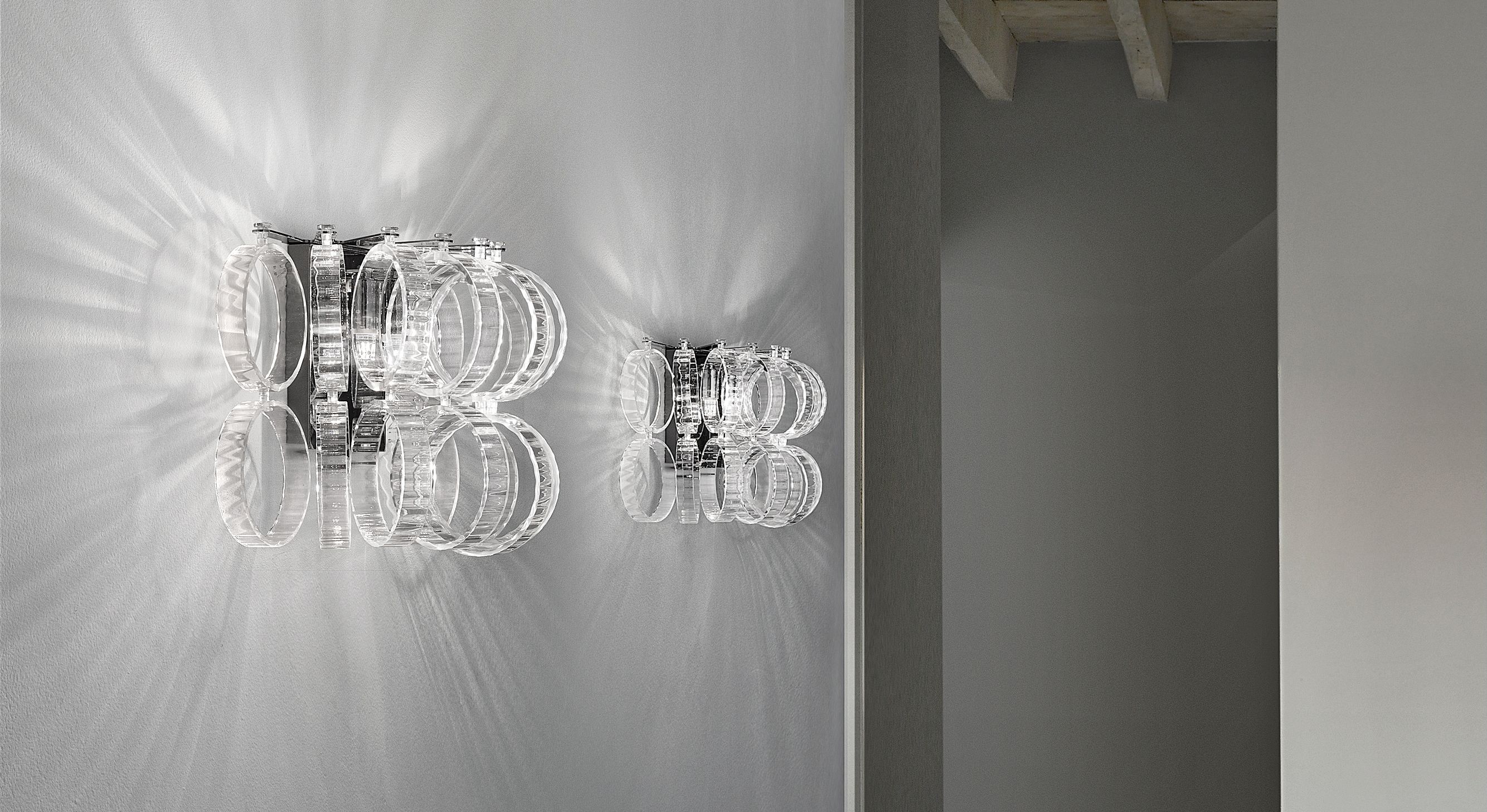
Ecos AP - Lusail Palace – Doha - Custom
The project stems from the need to create a wall lamp that would complement the Ecos collection, designed by Renato Toso, Noti Massari & Associati, and already used by the client for their pendant lamps. From this request, a shared journey unfolds, where the tradition of Murano glass meets the client's vision, giving rise to a new language of light.
Ecos is based on an essential principle: a ring as a modular matrix, capable of generating ever-changing compositions. Customizable in shape and size, the collection offers a wide variety of solutions thanks to shades ranging from white glass to rigadin crystal, crafted to create vibrant surfaces. The metal parts, in satin bronze or chrome finishes, complete the ensemble with understated elegance.
The initial brief called for a fixture made of metal and transparent glass, with a chrome finish and an invisible internal structure, with an aesthetic inspired by the subtle elegance of the 1960s, light proportions, and a uniform light, free of visible metal elements.
Starting from these specifications, Vistosi developed three design proposals.
The first envisioned using the entire Ecos blown glass, the original glass cylinder from which the rings are made, retained here in its complete form, without cuts. This solution preserved the purity of the glass and created a single, continuous surface.
The second option proposed cutting the blown glass into separate rings, thus echoing the compositional principle of Ecos. The rings would be arranged along a vertical axis, generating a luminous column.
Finally, a third proposal introduced a variation: a single blown glass, but with grooves engraved in the glass, suggesting the rhythm of the rings without interrupting the continuity of the surface.
After evaluating the three proposals, the client chose the version with separate rings, but requested a further intervention: the elements needed to be staggered, not perfectly aligned, to achieve a more dynamic and natural presence.
From this brief, a wall lamp was born that transfers the modular logic of Ecos to a vertical form, combining engineering precision and the poetry of blown glass in a balance of rigor and lightness.
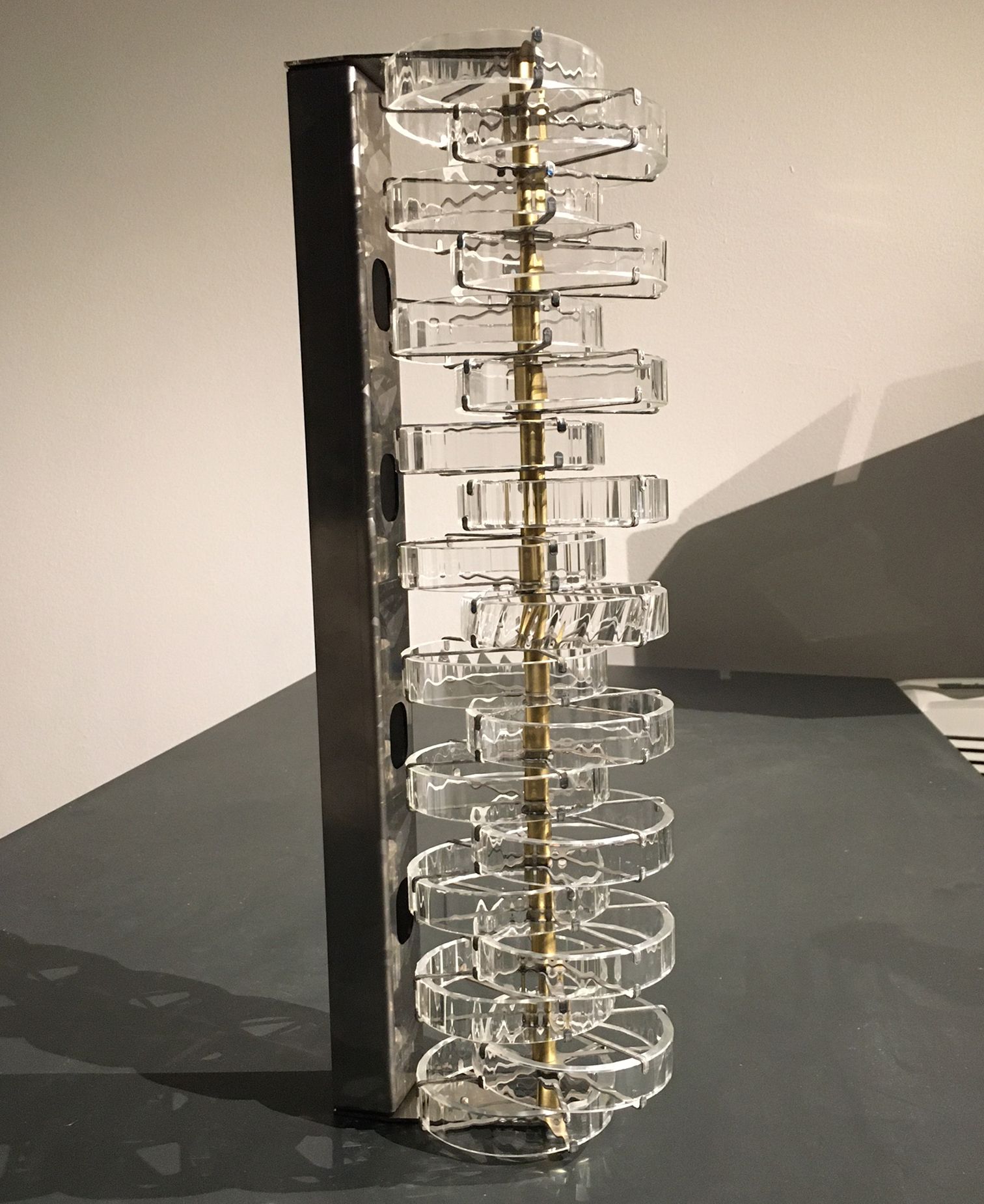
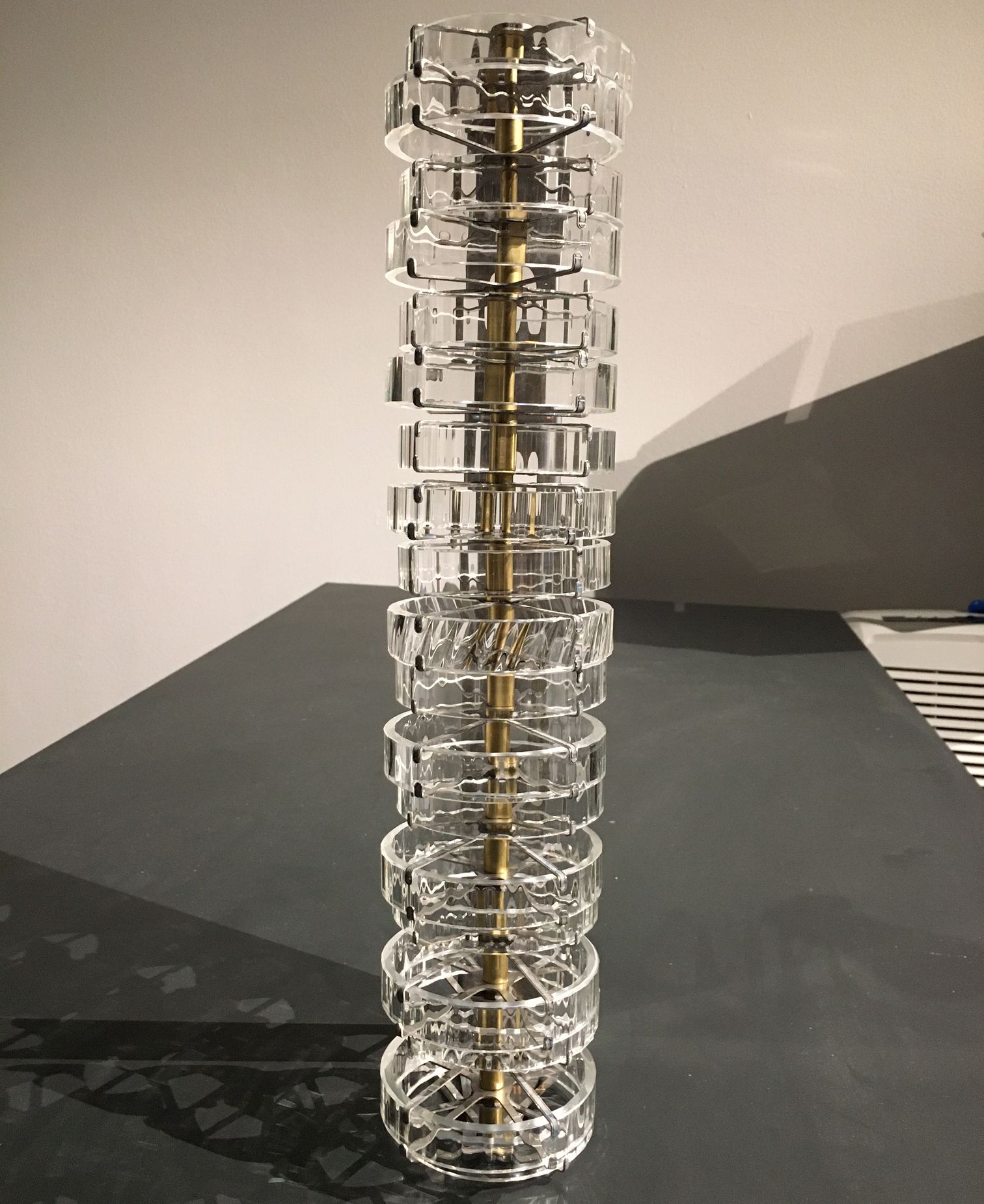
The lamp body is composed of a sequence of clear crystal rings, each crafted from a single Ecos blown glass. The rings, mounted on a polished chrome metal structure, are arranged in an irregular and controlled rhythm, supported by an invisible geometry that allows only the transparency of the glass to emerge.
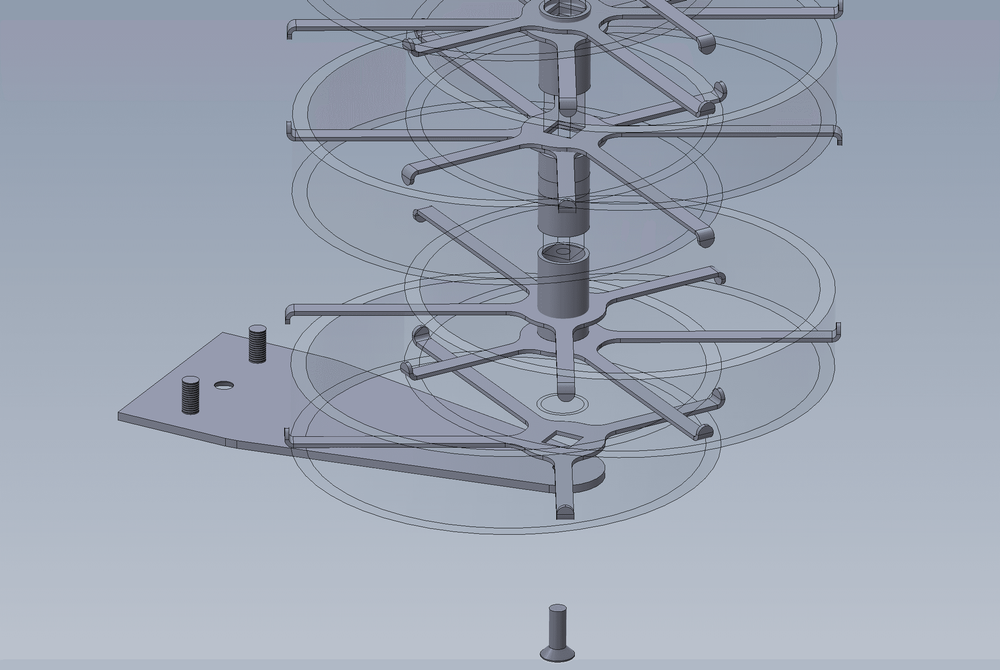
During the technical development, two mounting solutions were considered. The first involved drilling holes in the discs, thus attaching them directly to the metal structure. The second introduced a dedicated connection ring, capable of locking the rings without drilling them. This is the option chosen by Vistosi because it preserves the quality of blown glass while simultaneously ensuring precision and safety during assembly.
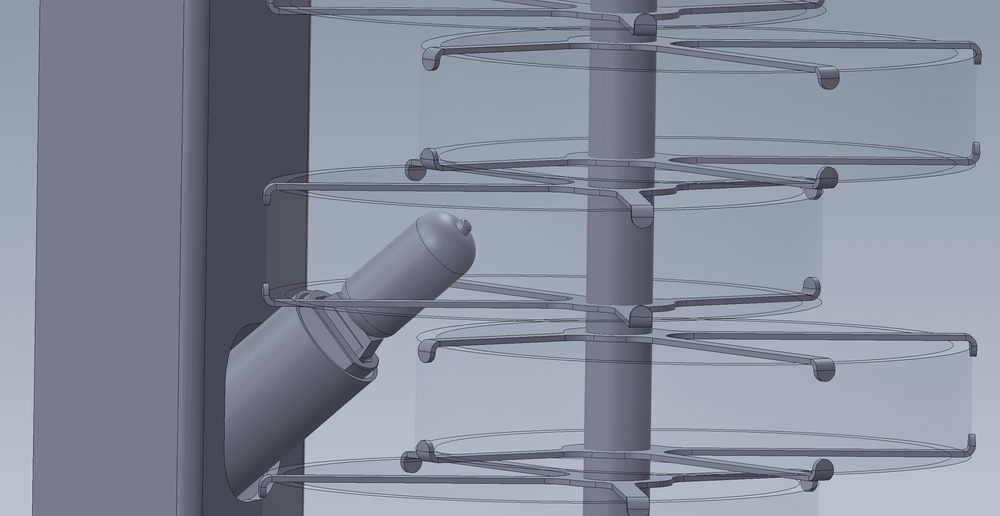
During the design process, the upper and lower mounting brackets underwent two evolutionary phases designed to optimize both the technical functionality and the aesthetic purity of the fixture. In the first configuration, the light unit and the glass support structure were attached separately to the wall bracket, requiring an additional connecting bracket and a large number of screws, which was inconsistent with the linearity required by the project.
To overcome these limitations, a second solution was developed, in which the light unit and glass are assembled together before the electrical connection. This configuration simplifies assembly, reduces visible elements, and uses the same screws with a dual structural function, resulting in a more essential and harmonious system, where technology becomes an integral part of the overall elegance.
Assembly follows a precise sequence: the base plate is fixed to the wall, the lower bracket is screwed onto the square profile, and the metal and glass components are gradually inserted until the entire light column is formed. The upper bracket closes the structure, while the glass assembly is anchored to the lamp holder via a system of dedicated pins and nuts, ensuring stability and safety. The entire lamp body is finally electrically connected and secured to the wall via two main anchoring points.
Inside, four G9 light sources distributed along the vertical axis generate a uniform, enveloping light. The staggered arrangement of the modules amplifies the transparency of the glass rings, creating a continuous visual flow. The result is a vibrant, material light, capable of transforming the wall lamp into a luminous sculpture, where every detail derives from a logic of precision and beauty.
For Vistosi, every custom project is a blend of craftsmanship, innovation, and technical rigor. The company interprets glass not simply as a material, but as a living substance, capable of shaping light, shadow, depth, and transparency. Vistosi's expertise spans the entire design cycle: from concept development to prototyping, from component manufacturing to certification, maintenance, and lighting design.
In the preliminary phase, the company carefully studies renderings and, if the concept is not technically feasible, proposes modifications in advance so the client can assess a realistic result. One of Vistosi's strengths is the fidelity between the design and the final result, often exceeding expectations.
In custom projects, Vistosi applies glass with rigorous control over color, transparency, thickness, and curvature, integrating the expertise of its workshops and specialized craftsmen with the precision of its technical office. Each component is developed in accordance with the original concept and subjected to detailed lighting tests to ensure that the light interacts synergistically with the glass, enhancing textures, reflections, and depth.
With this project, Vistosi reaffirms its ability to transform technique into an aesthetic language.
The lamp is the result of a constant dialogue between design and material, between the client's vision and the artisanal expertise that has shaped Murano glass for generations.
© 2024 Vetreria Vistosi srlVia Galileo Galilei, 9-9/A-1131021 Mogliano Veneto – TV (Italy)T. +39 041 5903480 / +39 041 5900170Email: vistosi@vistosi.itVAT No. IT02497840278Company Register No. 01808840266REA TV Registration No. 170728Share Capital €100,000.00
©2024 Vetreria Vistosi s.r.l. All rights reserved
Subscribe to our newsletter
Follow us on


