

Vico Magistretti
designer
Among the great masters of twentieth-century design and architecture, Vico Magistretti transformed simplicity into a form of design intelligence. Born in Milan in 1920, he was one of the key figures in Italian design, helping to define an essential, rigorous, and timeless language. His famous statement, "Simplicity is the most complicated thing in the world," perfectly sums up his approach to design, eliminating every superfluous element to make room for the essence of form and function.
After studying at the Liceo Classico Parini, he enrolled in the Faculty of Architecture at the Milan Polytechnic in 1939. During the war years, he moved to Switzerland, where he attended the Champ Universitaire Italien in Lausanne and met Ernesto Nathan Rogers, a key figure in his cultural development. Returning to Milan in 1945, he graduated in Architecture and began working in his father's studio, which would remain the center of his professional activity throughout his life. From here, an extraordinary career unfolded, developed with discretion and continuity, far removed from trends yet profoundly influential for entire generations of designers.
For Magistretti, architecture and design have always represented two expressions of the same discipline. From postwar Milanese residential buildings to large-scale urban projects, to objects destined for industrial production, each project stems from the search for a natural balance between function, construction, and form. His idea of modernity is not based on innovation for its own sake, but on the ability to create simple, intuitive, and enduring objects—qualities that have made many of his works true icons of international design.

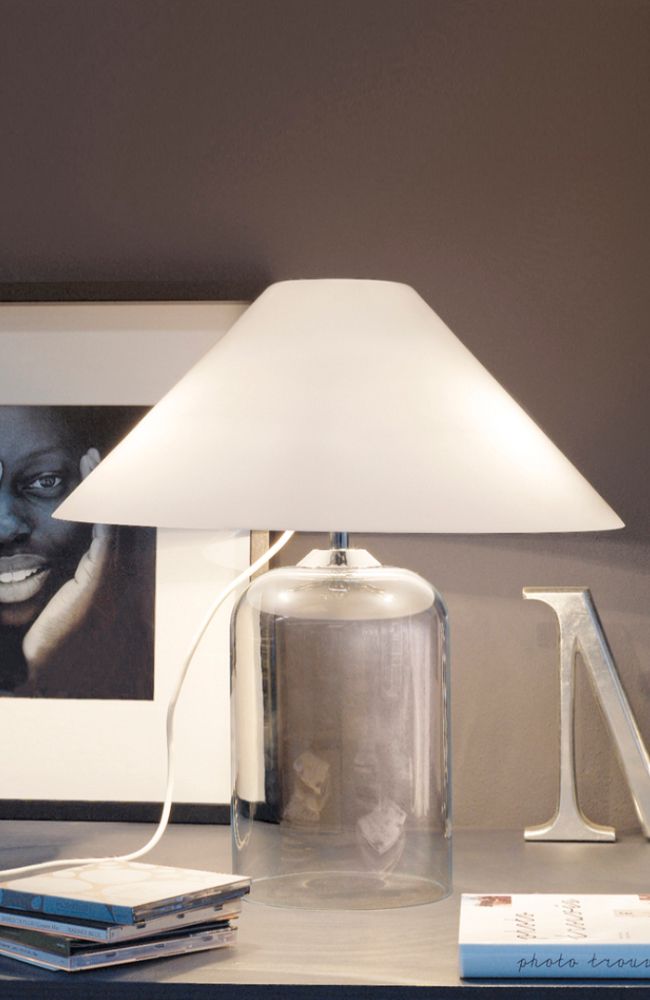
The collaboration with Vistosi is part of this ongoing research into the essentiality of form and the quality of light. For the company, he created the Alega collection in 1970, a lamp that interprets Murano blown glass through a sober and elegant language. The composition, characterized by the combination of a transparent base and a white glass diffuser, recalls the classic proportions of traditional lamps, reinterpreting them with the restraint and rigor typical of his design language. Alega perfectly embodies Magistretti's poetics: an object free of excess, where every detail responds to a precise function and where simplicity becomes the result of a sophisticated design synthesis.
Over the course of his career, Vico Magistretti received some of the most prestigious international awards, including three Compasso d'Oro Awards — for Eclisse, Maralunga, and Atollo — as well as the Compasso d'Oro Lifetime Achievement Award in 1994, the Gold Medal from the Society of Industrial Artists and Designers (SIAD), and the Abitare il Tempo special prize. His works are part of the permanent collections of institutions such as the Museum of Modern Art (MoMA) in New York, the Victoria and Albert Museum in London, and Die Neue Sammlung in Munich. After his death in 2006, his historic Milanese studio became the headquarters of the Vico Magistretti Foundation, which continues to preserve and promote a design legacy that demonstrates how true innovation arises from clarity of thought, honesty of function, and the elegance of simplicity.
Collections made with Vistosi
© 2024 Vetreria Vistosi srlVia Galileo Galilei, 9-9/A-1131021 Mogliano Veneto – TV (Italy)T. +39 041 5903480 / +39 041 5900170Email: vistosi@vistosi.itVAT No. IT02497840278Company Register No. 01808840266REA TV Registration No. 170728Share Capital €100,000.00
©2024 Vetreria Vistosi s.r.l. All rights reserved
Subscribe to our newsletter
Follow us on


