

Angelo Mangiarotti
designer
Few designers have marked the history of Italian design with the depth of Angelo Mangiarotti. Architect, designer, and sculptor, he dedicated his career to the pursuit of the perfect balance between form, function, and material, creating timeless works in which design rigor, technical innovation, and artistic sensibility coexist in harmony. For Mangiarotti, design arises from necessity: an object acquires value only when it is capable of concretely responding to people's needs, transforming function into an essential and lasting aesthetic experience.
This vision has guided all of his design work. "An object that is not born from necessity cannot be considered design," he loved to say, summarizing a thought that would profoundly influence contemporary design culture. The simplicity of his works was never an exercise in style, but the result of a rigorous research process in which materials, structure, and function interact until they achieve a natural balance.
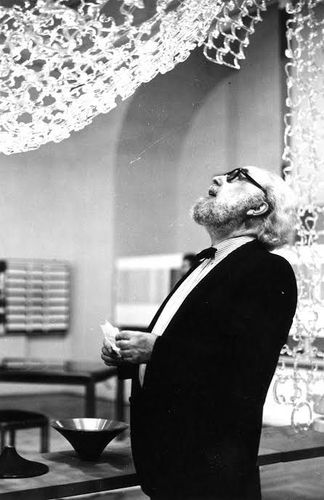
Born in Milan in 1921, he earned his degree in architecture from the Polytechnic University of Milan in 1948. After collaborating on the design of the 8th Milan Triennale, he had a formative experience in the United States, where he came into contact with leading figures in modern architecture such as Frank Lloyd Wright, Walter Gropius, Ludwig Mies van der Rohe, and Konrad Wachsmann. This decisive period solidified his interest in construction systems, prefabrication, and the relationship between industry and design.
Over the course of a career spanning more than sixty years, he worked as an architect, designer, urban planner, and professor, creating buildings, infrastructure, design objects, and sculptures. At the same time, he was deeply involved in academic work in Italy and abroad, contributing to the spread of a design culture grounded in an understanding of materials and production processes.
His research is distinguished by an almost scientific approach to materials. Marble, glass, wood, and metal are studied first for their structural properties rather than their aesthetic ones: it is the material itself that suggests the form. Every project arises from constructive logic, interlocking elements, the balance of forces, and modularity, transforming technique into an expressive language that represents one of his greatest contributions to the history of international design.
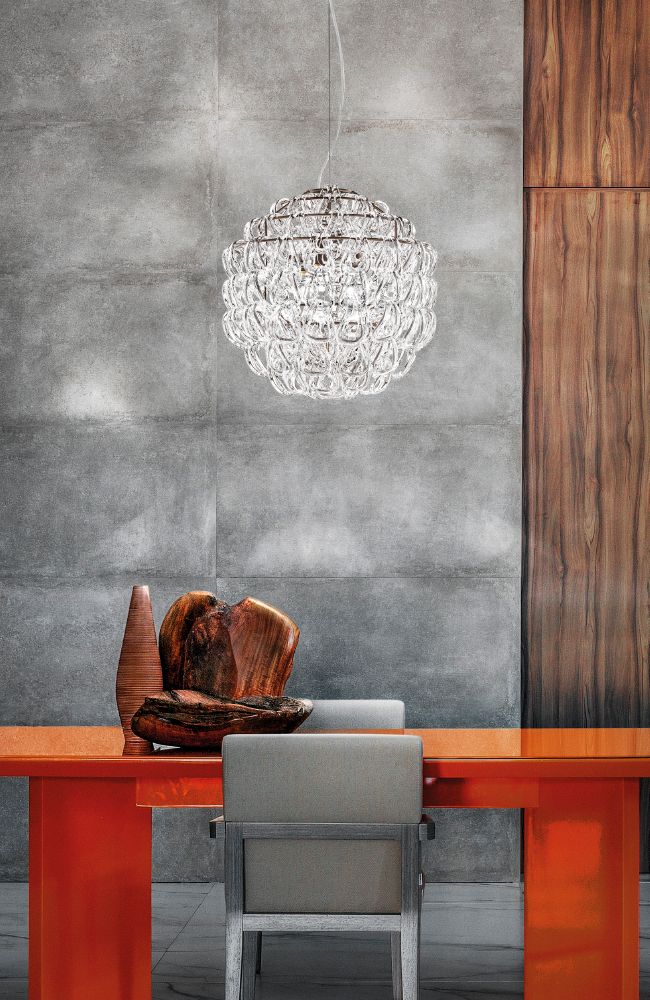
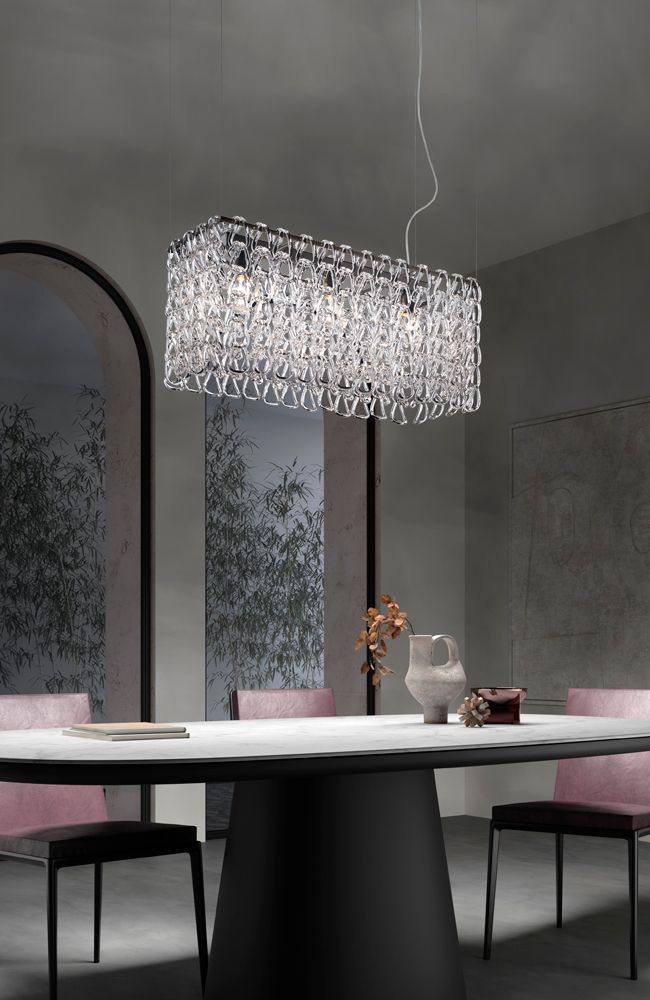
Among the most significant collaborations of his career is that with Vistosi, for whom he designed Giogali in 1967, destined to become one of the company's and Italian design's most iconic collections. The idea stems from a single modular element in hand-crafted crystal: a hook that, when repeated and connected to other identical elements, generates potentially infinite configurations. More than a chandelier, Giogali is an architectural system of light, capable of adapting to different contexts and scales while maintaining the strength of its design concept. Even today, it remains one of Vistosi's iconic collections and one of the longest-running in the catalog, having evolved over time, including the Minigiogali version, confirming the timelessness and extraordinary versatility of the original design.

Awards and recognitions
Throughout his career, Angelo Mangiarotti received numerous awards that testify to the value of his research in design and architecture. Among the most significant honors is the ADI Compasso d'Oro for Lifetime Achievement, awarded in 1994. This is one of the highest honors in Italian design, given for his contribution to design culture and his extraordinary ability to transform knowledge of materials into a timeless design language.
Over the years, he also received the Domus Formica Award (1956), the In/Arch Award for Lombardy, and the First National Prize of the Gulf of La Spezia for Industrial Design (1963), the Prix Européen de la Construction Métallique (1979), the Design Plus Award for the Ergonomica collection (1991), and the Marble Architectural Awards (1994), as well as numerous other international awards.
His design work is accompanied by important academic awards, including an Honorary Degree in Engineering from the Technical University of Munich in 1998 and an Honorary Degree in Industrial Design from the Polytechnic University of Milan in 2002, confirming his influence on design culture and the education of generations of designers and architects.
"In my projects, I've always tried to incorporate people's needs into the definition of the work. I'd say the fundamental starting point for designing a product lies in its usefulness to people. An object that isn't born out of necessity can't even be considered design."
Collections made with Vistosi
© 2024 Vetreria Vistosi srlVia Galileo Galilei, 9-9/A-1131021 Mogliano Veneto – TV (Italy)T. +39 041 5903480 / +39 041 5900170Email: vistosi@vistosi.itVAT No. IT02497840278Company Register No. 01808840266REA TV Registration No. 170728Share Capital €100,000.00
©2024 Vetreria Vistosi s.r.l. All rights reserved
Subscribe to our newsletter
Follow us on


